Post
Turtles All the Way Up
That pervasive question, “what are we doing here”, or more accurately, “what’s the fucking point” continues to steal away my attention (and sanity). Looking up is one impetus, but more recently looking inward has reignited my internal debate on our position in the universe and what role we might play on a larger scale.
Easily, and without qualification, the human body is the most exquisite machine we have discovered in our universe. Its design (excuse that term’s implications) and function are staggering in their complexity and ingenuity, and what we are capable of through our bodies simply begs for a “bigger picture”. As I look inward, I see that the functional units of the human form present an apt analogy for our own lives. The trillions of cells that comprise my body are not unlike the billions of people that inhabit this planet. The cells of a growing embryo differentiate into specialized cells with specific jobs in the larger organism, just as we might develop and contribute our abilities to a larger society.

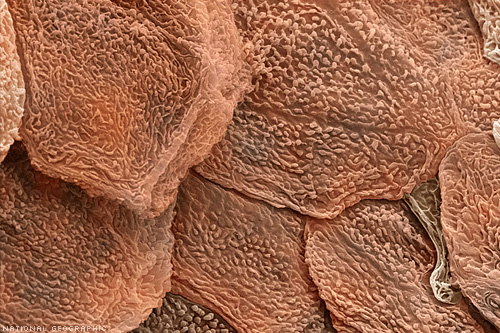
For example, red blood cells (erythrocytes) are an oxygen transport army, so specialized, in fact, that they’ve lost their nucleus and are essentially sacs of hemoglobin. As a result, they cannot synthesize their own proteins and are recycled frequently. The skin cells of the epidermis are similarly short-lived, just brushing your arm will cause millions of dead cells to slough off the outermost layer. Neurons, on the other hand, are cellular royalty. Extremely specialized, they detect stimuli and conduct electrical impulses controlling most of the autonomic and voluntary activities of the body, and more importantly they’re responsible for the higher-level functions of the brain.
Every cell plays its own role in the functioning of the larger organism, and some are more important that others. Even so, no single cell is essential for the survival of the organism, and even the regal neuron relies on an array of support cells (that outnumber it by a factor of ten) for its survival.
As one goes further down, the pattern repeats with constituent parts contributing to a larger function or set of properties (within an organ, a single cell, molecules, elements, subatomic particles, etc). What function do we participate in (and what role will I play), what about all those stars and galaxies? Is it “turtles all the way up”?
Archive
-
260.
The Ethics of Practicing Procedures on the Nearly Dead
The report from the field was not promising by any stretch, extensive trauma, and perhaps most importantly unknown “downtime” (referencing the period where the patient received no basic care like...
-
260.
The Ethics of Teaching Hospitals
I can’t imagine what the patient was thinking. Seeing my trembling hands approaching the lacerations on his face with a sharp needle. I tried to reassure him that I knew what I was doing, but the...
-
260.
Conscious Conversation: Behavioral Science
Dr. Eran Zaidel is a professor of Behavioral Neuroscience and faculty member at the Brain Research Institute at UCLA. His work focuses on hemispheric specialization and interhemispheric interaction...
-
260.
Progress Report
Two years down, I’m still going. The next two years are my clinical rotations, the actual hands-on training. It’s a scary prospect, responsibilities and such; but it’s equally exciting, after...
-
260.
Why Medical School Should Be Free
There’s a lot of really great doctors out there, but unfortunately, there’s also some bad ones. That’s a problem we don’t need to have, and I think it’s caused by some problems with the...
-
260.
The Cerebellum: a model for learning in the brain
I know, it’s been a while. Busy is no excuse though, as it is becoming clear that writing for erraticwisdom was an important part of exercising certain parts of my brain that I have neglected...
-
260.
Conscious Conversation: Philosophy
Daniel Black, author of Erectlocution, was kind enough to chat with me one day and we had a great discussion – have a listen.
-
260.
The Stuff in Between
I’m actually almost normal when not agonizing over robot production details, and quite a bit has happened since I last wrote an update. First, I’ve finally graduated. I had a bit of a...


Comments
If we remove ourselves from the language of “life,” and so from what seem to be artificial delimiters, and look instead at physical systems, it’s not so surprising that things would organize similarly at various orders of magnitude. Whether Gaia or not, we each contribute to the usage and change of our localities, and to progressively smaller degrees, the planet, the solar system, the galaxy, the local galactic group, etc. If in fact the universe is infinite, then our effect approaches none.
Assuming that much of what we have deduced of the nature of the universe comes, ultimately, from the breakage of symmetry in those fleeting Planck timeframes after the Big Bang, and assuming (a bit larger assumption, maybe) that the dimension or granularity of this breakage is fairly constant, or at least similarly proportional, at most/all scales, then we might expect similar patterns of organization all the way up and all the way down.
Daniel Black
Feb 24, 07:27 AM #
Very good point. Using the term “role” was probably a mistake on my part, its implications are a bit too teleological. As components in a larger system, each would still serve some function, no? Nobody would deny that the effect of one of those skin cells was virtually nil, but the cell itself serves to insulate, waterproof, etc. the body.
As the original components began to combine and aggregate in novel ways, their paths diverged, radiating from those early moments. When you have ridiculous amounts of time, those components develop in increasingly different ways. Two points on the periphery of opposite poles would vary significantly on larger scales. I think it’s turtles all the way down, but I highly doubt there are turtles anywhere else in the universe.
Thame
Mar 2, 12:29 PM #
You should read What is Life by Dorion Sagan and Lynn Margulis. It’s full of much much more of this. More interesting than how we live, perhaps, is why we die, which is also explained in the book.
>>Easily, and without qualification, the human body is the most exquisite machine we have discovered in our universe.
I think if you truly want to get at “what’s the point” and “why are we here,” etc, you need to grow beyond the human bias here. The human body is an exquisite machine, but all of life is exquisite. There’s nothing particularly superior about human life in the terms you’re using here: specialization, function, design… Miracles are everywhere. I really don’t think you can make progress on the issue with humans at the absolute center of the question.
scarabic
Mar 5, 08:31 PM #
That looks like a great book, parts are available on Google.
I think there is though, and that there’s nothing egotistical about putting us in the center. Our brains are far more advanced than any living thing on the planet; there’s a reason why we’re the only ones asking that question. When I ask “why am I here”, I’m asking it as a conscious individual, I want to know the reason for my existence (whether or not it’s common with others).
Thame
Mar 14, 03:10 PM #
We certainly are an egocentric group. What about the universe makes you think that the human concept of “purpose” exists apart from our own minds? Nothing I have seen in my short experience has lead me to believe that purpose is anything more than our attempt to impose order on our existence. What if the question “why” in reference to our existence has no answer other than what we choose to give it? You might save yourself some time, and sanity, if you were to let go of the idea of a universal why.
quijotesco
Mar 17, 10:45 AM #
I discovered this link from some “Top 50 Philosophy Websites” and I am impressed, but also annoyed that you don’t write more often (stupid med school). I am, however, surprised at your thinking about turtles “all the way up” though. I see your point looking downward—without fundamental particles, we wouldn’t have mitochondria, bacteria, skin cells, organs, humans, ecosystems. But—I am unclear how a healthy living planet has anything to do with the rest of the planets, the sun, galaxies, and so forth. A dead one is just as useful. It seems the link is broken before “life form” and after “living planet” because mass is about all the properties that we have to link larger astronomical entities with each other. While light conveys all sorts of information about chemical properties of the planet, as far as we can tell, chemistry (besides the amount) has nothing to do with how galaxies interact. Titan doesn’t affect Saturn or any of the other planets with its oceans of methane. The weather on Jupiter doesn’t affect Orion. And so forth. Perhaps I am wrong but linking beyond these levels feels like some need to be significant, rather than a scientific approach. (I have no trouble suggesting consciousness or humanity is significant, I just don’t think they are to the galaxies).
Carolyn
Jul 1, 07:14 PM #
I don’t know if human purpose is even a matter of choice, if we are limiting ourselves to science. Some would reduce it to a very complex response still geared toward survival: connection/collaboration, drive, curiosity toward learning and control of environment.
While I agree that there are many measures to greatness in the living kingdom (near immortality of some plants, near indestructiveness of tardigrades, sheer volume of living mass, longevity over epochs), the human brain is a wonder of evolutionary investment. The rest of us is otherwise just a delicious chicken nugget to so many other creatures. It is worth asking how this differs on an order of magnitude, that creates the culture (language, art, music, film, philosophy), social systems (government, money, technology, air traffic control), and disasters that are uniquely ours.
Carolyn
Jul 2, 05:08 AM #
Besides gravity, the only other known force to operate at those scales is entanglement, and I’m not sure we know enough to make claims about how one change affects another in a predictable way.
Carolyn
Jul 2, 05:17 AM #
Add a Comment
Phrase modifiers:
_emphasis_
*strong*
__italic__
**bold**
??citation??
-
deleted text-@code@Block modifiers:
bq. Blockquote
p. Paragraph
Links:
"linktext":http://example.com