Post
Ineffable Understanding
Near-death experiences, hallucinogenic trips, meditation, you’ve probably read about (or felt firsthand) the odd nature of these “out of body” experiences. A philosophically interesting consequence is the sense of understanding and intangible comprehension that often follows. Authors attempting to document these experiences typically produce almost nonsensical statements sprinkled with capitalizations, you know, where “now” becomes “Now” and immediately triples in metaphysical weight.
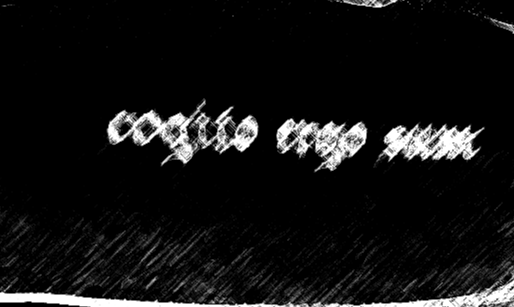
Joking aside, there is something ineffable about fully grasping a concept (which is what appears to happen in these cases). For me, one uninduced experience involved the cogito. I’d first come across it in a class and had no difficulty comprehending its role in Descartes’ argument, its wide-reaching impact, and even a couple flaws in its presentation. But, it wasn’t until a few weeks later that I fully grasped the concept while thinking quietly in my room. I can’t easily describe the immensity (sorry, “Immensity”) that the concept grew to in my head, but in that moment, I felt as if I had the same experience that Descrates did sitting by his fireplace, that I had razed the foundations of my knowledge to the ground and begun anew with one solid brick.

In my case, I did not gain any new information nor would I say that my ability to apply or process the concept had improved. What had happened was far more subtle and personal, but denying that something had happened would be foolish. What that something is, I don’t know (although the phrase “consciousness-expanding” rings true).
So, my question is, do these special experiences (NDE’s, drug-induced hallucinations, or meditation) introduce any new information or provide access to real knowledge, or do they just flick the “grasped” switch on things we already know?
Archive
-
260.
The Ethics of Practicing Procedures on the Nearly Dead
The report from the field was not promising by any stretch, extensive trauma, and perhaps most importantly unknown “downtime” (referencing the period where the patient received no basic care like...
-
260.
The Ethics of Teaching Hospitals
I can’t imagine what the patient was thinking. Seeing my trembling hands approaching the lacerations on his face with a sharp needle. I tried to reassure him that I knew what I was doing, but the...
-
260.
Conscious Conversation: Behavioral Science
Dr. Eran Zaidel is a professor of Behavioral Neuroscience and faculty member at the Brain Research Institute at UCLA. His work focuses on hemispheric specialization and interhemispheric interaction...
-
260.
Progress Report
Two years down, I’m still going. The next two years are my clinical rotations, the actual hands-on training. It’s a scary prospect, responsibilities and such; but it’s equally exciting, after...
-
260.
Why Medical School Should Be Free
There’s a lot of really great doctors out there, but unfortunately, there’s also some bad ones. That’s a problem we don’t need to have, and I think it’s caused by some problems with the...
-
260.
The Cerebellum: a model for learning in the brain
I know, it’s been a while. Busy is no excuse though, as it is becoming clear that writing for erraticwisdom was an important part of exercising certain parts of my brain that I have neglected...
-
260.
Conscious Conversation: Philosophy
Daniel Black, author of Erectlocution, was kind enough to chat with me one day and we had a great discussion – have a listen.
-
260.
The Stuff in Between
I’m actually almost normal when not agonizing over robot production details, and quite a bit has happened since I last wrote an update. First, I’ve finally graduated. I had a bit of a...


Comments
I think that it’s like Socrates said, (paraphrasing) everything is already in our head, we just need to ask the right question to pull it out. In other words our experiences just helps us connect the dots, which in turns introduce us to a whole new world of knowledge. That being said, our brain may not always connect the right dots. So whether they are actual “knowledge” is a different story. Conspiracy theory anyone?
Jonathan Solichin
Nov 30, 11:14 PM #
That’s an interesting connection (Plato/Socrates on recollection). I’m not sure how exactly we could have this inborn knowledge, but the idea that it can be unlocked seems compatible with these special experiences.
Thame
Dec 1, 02:06 PM #
Perhaps that after understanding the concept in class, and grasping why Descartes and other people adhere to this concept, you had integrated the cogito to your own mental world view, and suddenly all the things you had represented in this mental world view had seemed to fall into place and to make a whole lot of coherence and sense. The point is, I believe there is a difference between understanding something and integrating it to our own system of beliefs or theories (often the distinction between beliefs and theories isn’t clear!).
I have experienced the same kind of “ineffable” moments a few times in my life. I used to think of them in terms of intuition taking over my everyday reasoning and convincing me that this “special spark” of thought (for it really does come to my consciousness/attention like a spark) is intuitively right, or at least, is going in the right direction.
As an example, it has happened to me more than once to feel completely blocked on a math problem, to think intensely and rationally about it without success, and then, after I turn away from the problem out of frustration and put my brain on idle for a few minutes, a sudden realization hits me and gives me a right solution to the problem, which for some reason often turns out to be an elegant one, as opposed to one that I would have consciously stitched up using explicit logical and mathematical rules.
These “eureka!” events are very interesting phenomena indeed. Although I have attributed them in the past to “intuition”, I have recently realized that it is a rather vague term. Now I tend to describe these “spark moments” as the result of the spontaneous activation of some “shortcut reasoning pathways” on the surface of consciousness; that is, instead of consciously thinking “A, thus B, thus C”, my brain just consciously thinks “A, thus C”. This seems to imply a “leap of faith” for my conscious mind, perhaps resulting from the encapsulated nature of both consciousness and the rest of our brain’s unconscious processes: in order to accept the latter thought, my conscious processes need to have an implicit confidence in my brain’s unconscious, “underground”, “unspoken” reasoning.
Now, these “shortcut pathways” were perhaps preexisting but for some reason not accessed until the time of the “spark”. They could also have simply formed on the spot via “ectopic”, i.e. unusual, “interdisciplinary” neuronal connections that would take place when I switch my brain from two different “modes” of thinking (from “math, logical reasoning mode” to “idle, taking in the surrounding environment, sensory mode”), where at this point, the “sensory mode” would enter my consciousness, leaving the “math mode” to work in the background, outside of consciousness, and get back at me when it gets a “sparking” result. Obviously, it could also be due to tons of other things.
Thus, with the above hypothesis in view, no, we do not gain new information from these special mental events; we do not enter new data in our mental representations of the world. What we do gain, however, is at least the conscious knowledge of, or at most the creation of a new circuitry, perhaps of a different kind than the ones we were previously familiar with. In more graphical terms, it is not about changing the nodes, but the links between the nodes. And just like with computers, this kind of alteration is probably more powerful than the mere addition of new information to our networks.
I first tend to think of these “out of body” experiences as a distinct kind of phenomenon than the one I just discussed, that involves the action of different brain processes. “Out of body” experiences seem to have more to do with self-consciousness than with the communication between consciousness and the unconscious rest of the brain (this is pure personal extrapolation, by the way). Therefore, I do not think we can make a direct comparison between the two.
However, I do agree that “out of body” experiences could possibly give rise to “spark events” (for lack of a better term). In this case, I would say that people just change perspectives, “flick the ‘grasped’ switch” as you say, without witnessing new information, as in new data/content.
Oh dear… I still haven’t talked about the cogito, and I have plenty to say about it! I think I have already gotten carried away, so ‘ll leave it for another time. Thank you Thame for posting such great food for thought!
Gen
Dec 8, 07:40 PM #
I don’t imagine it’s supernatural. We already experience the seeping of cognitive grasp of ideas as we attempt to capture them, either in writing or visual art, or conversation. I very weakly hypothesize that it’s much less likely that we wouldn’t experience these sorts of cognitive flinches, what we might unironically call brainstorms, than that we would. Modulating the flow of sensory input would seem to obviously affect the metabolizing of existing information.
That’s kind of a nonchalant, almost asshat comment, I know—or it appears so. I kind of cringe a little when experiences begin to gain traction in other worlds, in the Greek aether maybe, when there are simpler, more plausible, and—in my mind (no pun intended)—more interesting explanations can be found. My wanderlust picques when I ponder information theoretic explanations, but dull when anything begins to remind me of Shirley MacClaine.
Daniel Black
Dec 9, 12:24 AM #
T – 3 hours and counting to finish some proofs, and here I am. This is my effort to leave my math mode alone in the hopes of reaping a spark event.
Gen, your comment contains my comment. Thanks for bringing an order of magnitude greater clarity to what I was trying to impart. I’m no neuroscientist, nor do I play one on TV; but I can’t help but fathom that our brains organize themselves without our direct effort, and as pathways are created that connect previously disparate sensory clusters, we’re inevitably to notice this new link. It is possible that these connections are overwhelmed by the storing of new sensory information, such that they fail more frequently in consciously active regions while other “writing” occurs. If this is the case, then it would not be surprising that we experience spark events more frequently in areas we aren’t actively writing to. More generally, there may be some types of links that are more disposed to forming outside direct cogitation.
As to the special experiences (NDEs, hallucinations, meditation), my guess is that they are not separate but rather in the extreme tails of the distribution of “normal” (not in the statistical sense) experiences. If I experience a spark that helps me prove an argument, and if this results from the creation of new links between existing information, why mightn’t I experience a more dramatic spark when a larger web of links is created? Seems reasonable to assume that shock to the body may “merely” be a strong example of backgrounding one or more cognitive processes, and the brain, used to making connections in these hinterlands, makes a larger set of connections with a larger playground of backgrounded processes.
I’m less than coherent at the moment, so I hope this reads well enough.
Daniel Black
Dec 10, 12:32 AM #
When you are trying to grasp something desperately and urgently, your thoughts are constantly narrowing. You begin to compress all possibilities and thus you will frustrate yourself and eventually give up. When you are in a relaxed and calmer state, your brain is open to all possibilites, you begin to think more clearly.
It always occurs to everyone, we just don’t notice it. Have you ever been in a situation where you wanted to remember the name of a person, a store, or someone’s phone number. You start thinking about desperately untill you acknowledge that you have forgotten it. In reality, you haven’t forgotten it. You are just not thinking clearly enough, you are thinking narrowly and this makes it impossible for you to remember what you want.
Now when you are sitting somewhere quitely, it finally hits you. This is the same as the situation you mentioned. I think meditation simply puts you in a clearer state of mind. You enter a higher level of awareness
oso
Dec 15, 08:26 PM #
Well, to be more objective – I think there is a clear distinction between, involuntary, and “out of body.” The fact of the matter is, your body is more conscious than your mind is. In fact, you observe and register so much information, that if it were to be told to you, a whole day can fly by – easily! I think the “eureka” moments are the results of actually a study that was conducted, that I cannot begin to recollect at the moment, but there is a node in the brain that activates, but for some odd reason doesn’t notify the memory portion of your brain that you either remember, or are conscious of an issue. I have had many extremely odd moments like that, and given the fact that a majority of us have had it – it is of no amazement to me. (You’d be surprised on how many Network and computer related issues I solve in my sleep!)
Now the issue of out of body, contributed with either death, or hallucinogens, well, hallucinogens to that effect is another story, and is completely palpable. Out of body experiences are amazing, even to me. I can’t explain them, nor will I approach explaining them – but they are sensationalized. Never before have I seen a phenomena blown to epic proportions, have had selective, conspicuous emphasis placed on them to explain the unknown.
Fact of the matter is, and I agree with the last post – your brain is by far, one of the most sensitive portions of your body. It needs conditions to think and make sense of things. Philosophy tends to turn it on its head, not to mention drains people like me to become apathetic towards the subject. This happens with religion, and any issue that you feel strongly about – in some way shape or form, your mind will conform to the situation – it’s endemic to the domain, we’re all human. The only reason we have been able to survive on this planet, despite all the various placed against us, is because we can adapt. Your mind is a living example.
Mike
Dec 21, 08:59 PM #
Seems like there is a great deal of our unconscious/creative/imaginative/
innovative/emotional/spirit?/creative muse/whatever-you-want-to-call-it selves some of which Daniel Kahnemann discussed in his book “Thinking: Fast and Slow”. It seems presumptuous to simply assume all our thinking is step-by-step logical, conscious, rational and dismiss anything else as ‘mystical’.
What I think is more interesting, is that AI might be able to tap into far more effectively, is our ‘collective human mind’, all the information out there that no single human can learn and integrate, but that we all do as a collective 7-billion-brain effort: via culture, literature, philosophy, history, fields of study. Clearly we have a ridiculous amount of knowledge, but few places to discover patterns across disciplines. Still, it is unclear to me how information translates into morals.
If we are purely scientific, why do we need to leave any legacy at all? Why intentionally propagate a species? Why can’t we just come and go like any other animal? What these three pieces seem to be saying is that, despite our evil, we must have something vital to the universe, this consciousness (Consciousness?) that even we who are acutely aware of the ills of the world feel is an irreplaceable contribution.
I would go as far as to say that what some of the species does, does not implicate all of the species. While each of us contains the seeds for both good and evil, as do our social structures, we recognize historical breaking points, where we begin to believe our survival is at stake and that’s when all hell breaks loose. It seems more important to recognize, acknowledge and interrupt the process than to create a new (mechanical/technological) species (to do what? clean up our mess? why does anything need to replace us?).
C
Jul 2, 09:46 AM #
Add a Comment
Phrase modifiers:
_emphasis_
*strong*
__italic__
**bold**
??citation??
-
deleted text-@code@Block modifiers:
bq. Blockquote
p. Paragraph
Links:
"linktext":http://example.com